Future-Fit entrepreneurship: why sustainability is your new revenue model
BLOG
Companies that really want to be future-fit must structurally connect financial and social value. But how do you make that step from good intentions to concrete action?
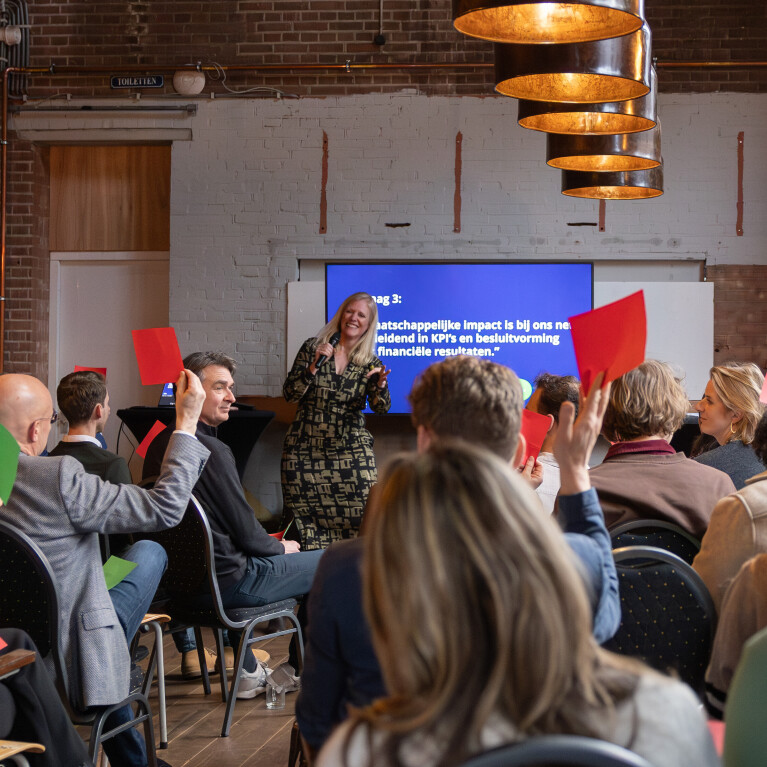
The world in which companies operate has changed fundamentally. Volatile, uncertain, complex and ambiguous – in other words, a VUCA environment, as emeritus professor and strategic sustainability thinker Rob van Tulder calls it. In such a context, reactive management is no longer sufficient. During a belated New Year's meeting of consultancy firm TOSCA on Future-Fit entrepreneurship, it became clear that organizations must choose: invest in resilience and long-term survival, or get stuck in outdated business models. 'Technology alone is not going to save us here,' Van Tulder stated in his introduction. 'It's about leadership, culture and daring to develop new business models.' Van Tulder refers to a video series in which he shows in five episodes how organizations can deal strategically with the current VUCA world.
The gap between ambition and implementation
Most organizations have now formulated a sustainability ambition. Yet the actual impact often falls behind. Van Tulder points to a crucial bottleneck: the translation of strategy into daily practice. To bridge this gap, RSM, Impact Centre Erasmus and TOSCA developed the Future-Fit Accelerator, a program for companies that combines training and hands-on guidance on sustainable strategies and transformation. Starting position and results are measured via the Better Business Scan.
The Future-Fit Accelerator maps out blockages. Is there a lack of leadership? Ownership? Cohesion between departments? Or is the problem in governance and decision-making? The outcome is not a scorecard, but a framework of priorities that brings focus. Then an accelerator team from the company gets to work on its own sustainability issue.
The most important insight? Sustainability only works if there is a shared vision and purpose underneath. Compliance can be a starting point, but never the end station. Van Tulder: 'Future Fit requires a proactive strategy. And that is different from ticking off a list of measures.'
What front runners do differently
During the meeting, several companies shared their approach. Remarkably, family businesses and cooperatives often turn out to be more agile than listed companies. Their hybrid character – with attention to both continuity and social impact – gives them a head start.
At ADG, a large Dutch family business with operating companies in facilities (such as Asito and Draaijer Heyday) and in care & safety (such as TSN Zorg and ZDG), happiness at work is central to the sustainability programme. The company measures employee engagement annually through the happiness at work index and structurally invests in Equal Opportunities, Development and Well-being. "Inclusivity, sustainable employability, psychological safety and connectedness are not soft topics," emphasizes ESG manager Karen Klein Douwel. 'They are the preconditions for long-term value.''
Royal Terberg Group embeds sustainability in three pillars: climate, circularity and health & safety. Transparent reporting and positioning sustainability throughout the organization creates cohesion, says Group Sustainability Manager Leonie Jesse. At the same time, the internal challenge remains recognizable: developing a shared language so that sustainability does not feel like activism, but as part of the business.
Modular builder Daiwa House Modular Europe shows how sustainability pays off commercially. Circular housing and reusable materials are not an idealistic goal, but an answer to concrete market demand. 'CO₂ reduction is increasingly being explicitly requested in tenders,' says Head of Sales & Marketing Michiel Gieben. 'ESG is therefore no longer an extra layer, but a core part of the proposition'.
The market as an accelerator
An important driver towards Future-Fit is the market itself. Customers, investors and partners are making increasingly stringent demands in the field of sustainability. Organizations that do not integrate ESG into their offerings are demonstrably missing out on assignments.
This explains why it pays to actively involve sales and marketing in the transition. By translating sustainability into customer language and linking market developments back to the business, internal acceleration is created. Commercial interests and sustainable goals are aligned, which increases the involvement of management and operations.
Leadership and culture as a foundation
Future-Fit stands or falls with leadership. It is not without reason that a large part of executive recruitment is now aimed at leaders with a clear vision of sustainability. Future-Fit leaders think systemically, recognize barriers and dare to break through them.
The role of change agents and intrapreneurs is also crucial: employees who connect departments and take ownership. They ensure that sustainability does not get stuck in strategy or reporting, but lands in purchasing, HR, finance and marketing.
Culture change is not an afterthought. Employees are not a cost item, but the most important asset. Organizations that take this seriously build support and innovative power more quickly.
Measuring what matters
Traditional KPIs fall short, Van Tulder argued. They often give a semblance of control, but little strategic insight. Future-Fit requires a broader measurement framework, in which, in addition to performance, decisions, processes and behavior are also included.
Instead of just key performance indicators, he argues for a combination of key value, key decisions and key practice indicators. Reporting only follows at the end. Without vision and implementation, reporting remains empty – and implausible.
Strategic transformation
Becoming Future-Fit is not a sustainability project, but a strategic transformation. It requires vision, leadership and the courage to rethink existing business models. Organizations that take that step are better prepared for uncertainty, more attractive to talent, and more relevant to their customers.
If you want to know more about the Future-Fit Accelerator, look here.
Back to news