More people working on sustainability does not mean more momentum
BLOG
Once upon a time...there was a sustainability manager who single-handedly launched sustainability initiatives within a company. Building support and fostering collaboration were part of her job, too, but when it came to actually getting things done, she was often on her own. Not great for the sustainability manager, but crystal clear for the rest of the organization: that’s what we have her for.
Fortunately, in most organizations this fairy tale is now a thing of the past. Many companies now have a broader team responsible for developing and executing their sustainability strategy. The obvious initiatives within the company have been tackled or are underway. And thanks to a materiality assessment and/or stakeholder engagement, more and more organizations have a clear view of which topics are most relevant to address. Some of these can be solved within the organization, but many are systemic issues that call for working together with others across the sector or value chain. As a result, responsibility for these sustainability topics now rests with a much larger group of employees, not just the people who have sustainability in their job title and in their hearts. So how do you bring all of these people along?
Is a 6 Out of 10 Good Enough for Change?
Recent research on the sustainable transition shows that business decision-makers give their own organization a 6.6 out of 10 for its work on the sustainable transition. The Netherlands as a whole gets a 5.5, a full 20 percent lower than their own organization. The higher up the hierarchy, the rosier the picture. That’s a problem, because strategic decisions are made at the top. Leadership sees ambition and progress; people on the front lines also see the roadblocks, the slow processes, and the targets that look good on paper but chafe in practice.
Of all the organizations in that study, 83 percent had sustainability goals. That sounds promising, but 56 percent barely measure their impact, if at all. And when asked whether leaders are held accountable for those goals, 30 percent said no, and another 30 percent said only to a limited extent. Just 19 percent feel that managers are truly held to account. This gets to the heart of the problem. In many organizations, sustainability is part of the strategy but not yet part of the culture. And whatever does not carry real weight in performance reviews, compensation, and decision-making tends to lose out to short-term goals. So the question is not whether you want to embed sustainability, but how. We distinguish four quadrants.
Embedding Sustainability in Your Culture
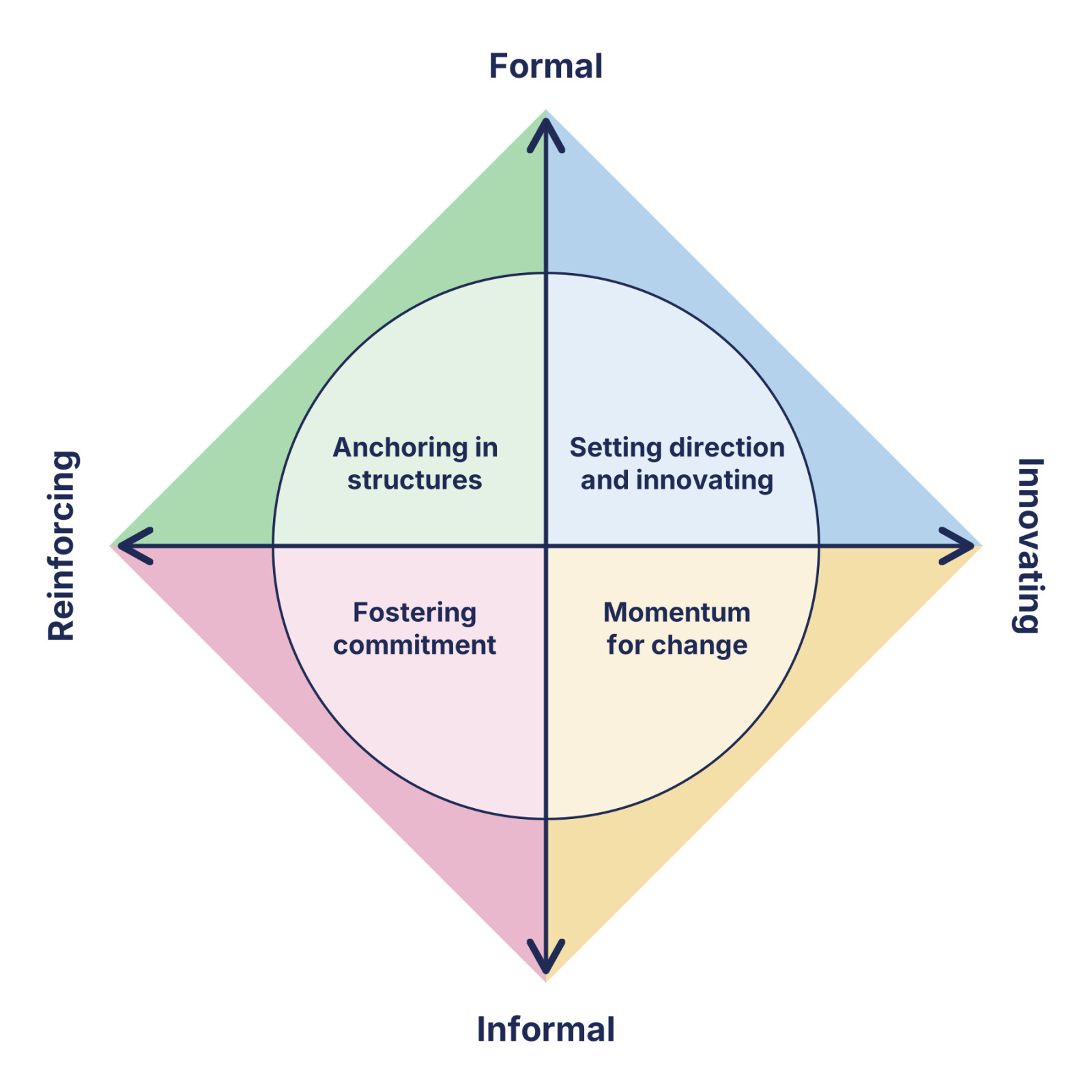
There is no one-size-fits-all recipe for embedding sustainability in corporate culture. But there are many practices that can contribute. You can map them along two axes: formal versus informal, and focused on achieving established goals versus further developing strategy and solutions.
Formal practices rely on rules, procedures, systems, and metrics. Informal practices are different: they focus on establishing and reinforcing shared ways of working, and in doing so, they target norms. Delivering on existing sustainability practices and commitments stands in contrast to further developing the path toward sustainability through innovation inside and outside the company.
Combining these axes creates four quadrants. Moving clockwise, each one makes its own contribution to embedding sustainability in a company. It starts with formal practices for continuous development and improvement, such as crafting a strong strategy for change and consistently factoring sustainability into decision-making. Shared values and attention to internal change champions are informal practices that build and sustain momentum for change.
Informal practices focused on achieving goals build employee commitment, for example internal gatherings where best practices are shared and teams collaborate to solve issues. Formal practices focused on achieving established goals make the direction and expectations clear. Factoring sustainability into performance reviews and compensation are examples of this.
That fourth quadrant is often the first one we think of when trying to drive change, and the research shows that we aren’t even doing that very consistently. Fortunately, effective interventions can be found in every quadrant, tailored to the company and where it stands in integrating sustainability into the organization. With the right combination of practices, fairy tales really can come true.
Want a quick snapshot of how your organization scores across the four quadrants and which additional interventions might help? Take this quick scan, or get in touch with Ulrike de Jong or Marjolein Baghuis. We would be happy to discuss your results and how you can use the scan further within your organization.
Back to news