New steps in our collaboration with Daiwa House Modular Europe
Daiwa House Modular Europe
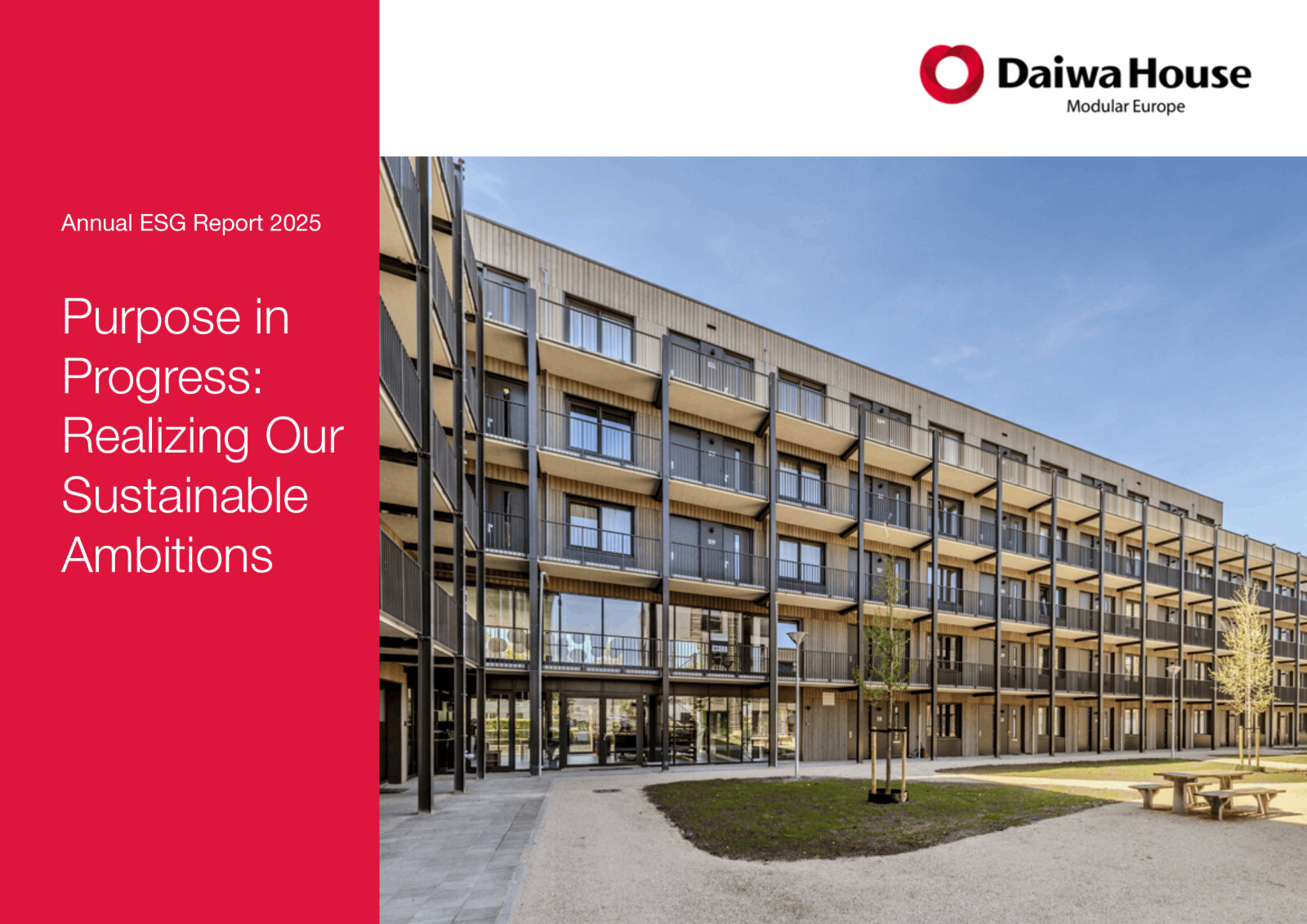
TOSCA has been working with Daiwa House Modular Europe (DHME) for five years now. Last year, the primary focus was on re-conducting the double materiality assessment and drafting policy documents. That effort did not go unnoticed: DHME was nominated for the 2025 CSRD Awards, standing alongside major names like AkzoNobel, Stedin, and Heijmans as a non-CSRD-obligated organization. Another year has passed, and that calls for a brief update.
From Policy to KPIs
The past few years, we have laid a solid foundation: a double materiality assessment, an ESG roadmap, a climate transition plan, and formal policies covering all material topics. This year, the focus shifted to reassessing goals established a few years ago using the most recent data. Doing this effectively required close collaboration with multiple departments within DHME, including HR, Finance, Sustainability, Safety, and Marketing & Commercial. This allowed us to refine the right KPIs, bringing the report another step closer to the organization’s day-to-day reality. Equally important is the capacity building within DHME’s core team, where sustainability is now firmly embedded. This enhances credibility when reporting to clients and financiers. The main challenge moving forward is embedding sustainability across the entire organization.
And from KPIs to Strategy
At TOSCA, we believe that reporting can serve as a valuable tool to help companies future-proof their business. Part of this involves aligning the previously defined topics and KPIs with strategic priorities. This proved to be a valuable intermediate step for the year, giving DHME a strong foundation to build upon next year. See the table below for DHME’s four strategic pillars and their corresponding KPIs:
| Strategic Pillar | Associated KPIs |
| Healthy and financial organization | Houses delivered, occupancy rate, market share (NL), customer satisfaction |
| Safe & engaging people | GHG emissions, Building Material Performance (MPG), mono / recycle streams, generated renewable energy |
| Flexible & efficient solutions | Absenteeism rate, employee engagement, safety ladder, injury frequency rate |
| Circularity | Revenue, solvency, payment practices |
Although DHME is not legally subject to the CSRD, they consciously choose to follow its guidelines. This is no coincidence: clients are increasingly requesting proof regarding aspects like CO₂ emissions or circularity percentages. Furthermore, reliable supply chain data is becoming vital for tenders and financing. In this way, sustainability is rapidly shifting into a baseline requirement for organizations.
Read the full annual report here: